
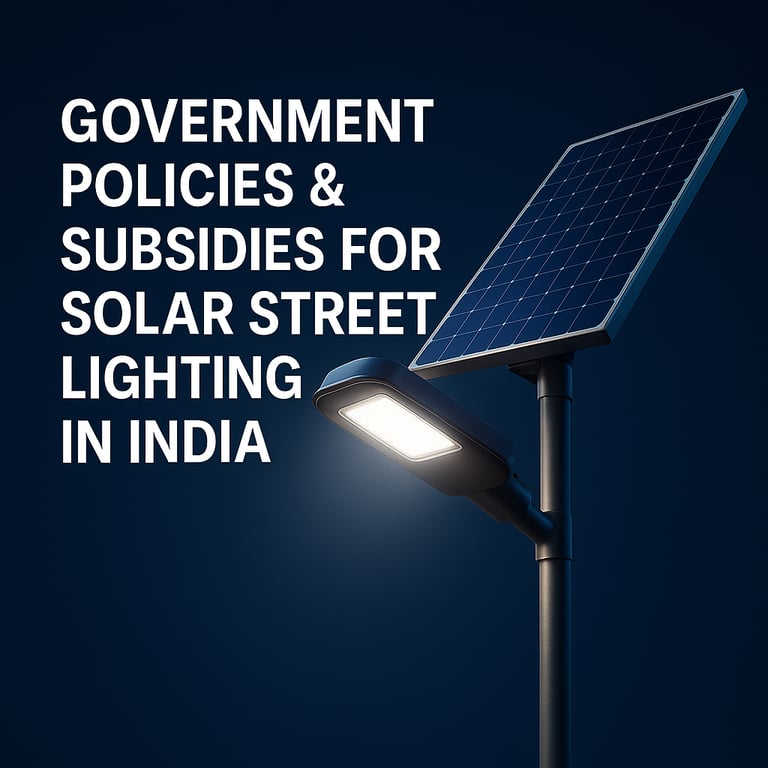
Government Policies & Subsidies for Solar Street Lighting in India
Useful for commercial buyers and institutions
11/19/20254 min read
Introduction
As businesses, municipalities, and institutions look to upgrade infrastructure and pursue sustainability goals, solar street lighting presents a powerful opportunity. Not only can you reduce operating costs and enhance public safety, but you can also tap into various government incentives in India that make the transition more affordable. This guide covers key policies, schemes, and subsidy frameworks relevant to solar street lighting, and how commercial/ institutional buyers can leverage them.
Why Government Policies Matter for Solar Street Lighting
When institutions such as factories, township developers, educational campuses, or municipal bodies adopt solar street lighting systems, the initial investment can appear substantial. Government subsidies, grants, and central and state-level incentives reduce capital cost, accelerate payback, and make the economics more compelling. Additionally, alignment with government renewable energy targets and regulations can help institutions meet ESG (Environmental, Social & Governance) commitments, secure financing, and build reputation.
Key National Schemes & Programmes
1. The Off-Grid & Decentralised Solar PV Applications Programme (by Ministry of New and Renewable Energy (MNRE)
This programme covers off-grid solutions, including solar street lighting systems, particularly in areas where grid power is unavailable or unreliable. Ministry of New and Renewable Energy+2Vikaspedia+2 It has defined phases of installation targets and provides central financial assistance (CFA) for approved units. Ministry of New and Renewable Energy
2. Atal Jyoti Yojana (AJAY)
Under AJAY, the focus was on installing solar street lighting systems in states with less than 50 % grid household coverage (as per the 2011 census), such as in the northeast, hilly states and aspirational districts. Ministry of New and Renewable Energy+1 The scheme provided for a combination of funding from MPLADS (Member of Parliament Local Area Development Scheme) and MNRE grant. Vikaspedia
3. LED-Based Solar Street Lighting Systems Scheme
Some state-level implementation under MNRE guidelines: For example, Gujarat’s scheme lists assistance of Rs. 4,000 per solar street lighting system and Rs. 20,000 per solar high mast lighting system under the state’s LED-based solar street lighting systems programme. hareda.gov.in Another document shows a 70% share by the State Govt/beneficiary and 30% by MNRE in some cases. peda.gov.in
What These Schemes Offer for Commercial & Institutional Buyers
Capital Subsidy: Many schemes provide a portion of the cost as a subsidy or grant, reducing upfront investment.
Lowered Financing Requirements: With subsidy support, the remaining cost can be financed more easily.
Faster Payback: Reduced upfront cost improves the return on investment (ROI) and payback period for institutions.
Support for Rural or Remote Deployments: Especially useful for campuses in remote areas, industrial parks, and housing developments where grid access is weak.
Eligibility for Large Scale Projects: Though many schemes focus on rural or off-grid, some states may include commercial/ institutional projects, depending on policy.
Eligibility and Key Conditions (What To Watch)
Location & Prior Grid Coverage: Some schemes prioritize regions with less than 50% grid household coverage. For example, AJAY. Ministry of New and Renewable Energy
Approved Vendor/Technology Standards: Use of MNRE-approved components, compliance with BIS/IEC standards is often required.
Project Size & Type: While many subsidies are designed for village or rural lighting, commercial/institutional buyers should verify if their project type qualifies or if separate guidelines apply.
Application Process & Documentation: Requirement for applications through state nodal agencies or phasing of subsidies (some upfront, some after installation).
Maintenance & Ownership: Often, beneficiaries must maintain systems for a minimum period. Some schemes may require a local government/beneficiary share.
State-Level Variations & Additional Incentives
State governments in India often add extra incentives on top of central subsidies. For instance:
Some states provide fixed per-unit grants for solar street lighting systems.
Others may permit faster approvals or tax breaks for renewable energy installations.
Customized policies for smart city lighting upgrades may include remote monitoring or IoT integration support.
Commercial buyers should check the policy of the specific state (or union territory) where their project is located
Practical Steps for Commercial & Institutional Buyers
Identify the Right Scheme: Check the central & state programmes applicable to solar street lighting in your state.
Cost-Benefit Analysis: With subsidy incorporated, calculate payback period (including savings on electricity, reduced maintenance).
Select Quality Components: Ensure solar panels, batteries, and LEDs meet approved standards – required for subsidy eligibility.
Engage with Nodal Agency: Work with the state renewable energy agency or utility to understand the application, inspection and subsidy release process.
Procure and Install: After sanction, purchase components, and undertake installation as per guidelines.
Post-Installation Compliance: Ensure commissioning, testing, reporting to receive subsidy and meet the maintenance requirements.
Monitor Performance: For institutional buyers, generating data on energy savings and reduced grid usage adds value for internal reporting and ESG disclosures..
Challenges & Things to Keep in Mind
Policy Changes: Subsidy levels and scheme eligibility can change, so stay updated.
Scope for Commercial Projects: Many subsidies are targeted at rural or off-grid public lighting – commercial buyers may have limited direct grants, so check specifics.
Quality Assurance: Using sub-standard equipment can void subsidy eligibility or degrade performance.
Maintenance & Theft: For public lighting in open areas, vandalism or theft of batteries/panels can be risks (especially in municipal settings).
Integration with Existing Infrastructure: Coordinate with utilities & local authorities if grid-interaction, net metering or maintenance are involved.
Case Study Snapshot
Although specific to residential rooftop solar, the ramp-up of central incentives shows the potential of government support. For example, under the Pradhan Mantri Surya Ghar Muft Bijli Yojana, launched in 2024, households receive substantial subsidies and are encouraged to generate up to 300 units/month of free electricity. Wikipedia+1 While this is for rooftop solar, similar momentum in policy for solar street lights emphasises the growing government support for clean outdoor lighting too.
Conclusion
For commercial buyers and institutional stakeholders looking at solar street lighting, government policies and subsidies in India present a strong enabler — reducing costs, improving financial viability, and aligning with sustainability goals. The key is to understand applicable schemes, match project eligibility, and execute quality installations. Armed with the right knowledge and partners, you can make solar street lighting a strategic, cost-effective and future-ready investment.
About Us
We are a team of passionate people whose goal is to improve everyone's life through disruptive products. We build great products to solve your business problems.
Our products are designed for small to medium-sized companies willing to optimize their performance.
Contact with us
© 2025 Suryaveda Projects Private Limited. All Rights Reserved.


Call Us: +91 9978652291


Email: info@suryavedaprojects.in