
What Are Solar Street Lights? A Complete Beginner’s Guide
A comprehensive, deeply informative guide for buyers, engineers, contractors, and government planners.
11/19/20254 min read

Introduction: Why Solar Street Lighting Is the Future
In the last decade, global energy demands have increased rapidly, and so have concerns about electricity costs, carbon emissions, and infrastructure maintenance. Traditional street lights depend on grid electricity, heavy wiring, high maintenance, and are vulnerable to power cuts.
Solar street lights provide a perfect solution — cost-efficient, eco-friendly, and independent from the electrical grid. As a result, they are now used in urban cities, on highways, in rural villages, smart townships, industrial parks, universities, airports, ports, and government projects.
In this article, you’ll learn everything about solar street lights, from how they work to technical components, performance metrics, types, applications, and how to choose the right system.
What Exactly Are Solar Street Lights?
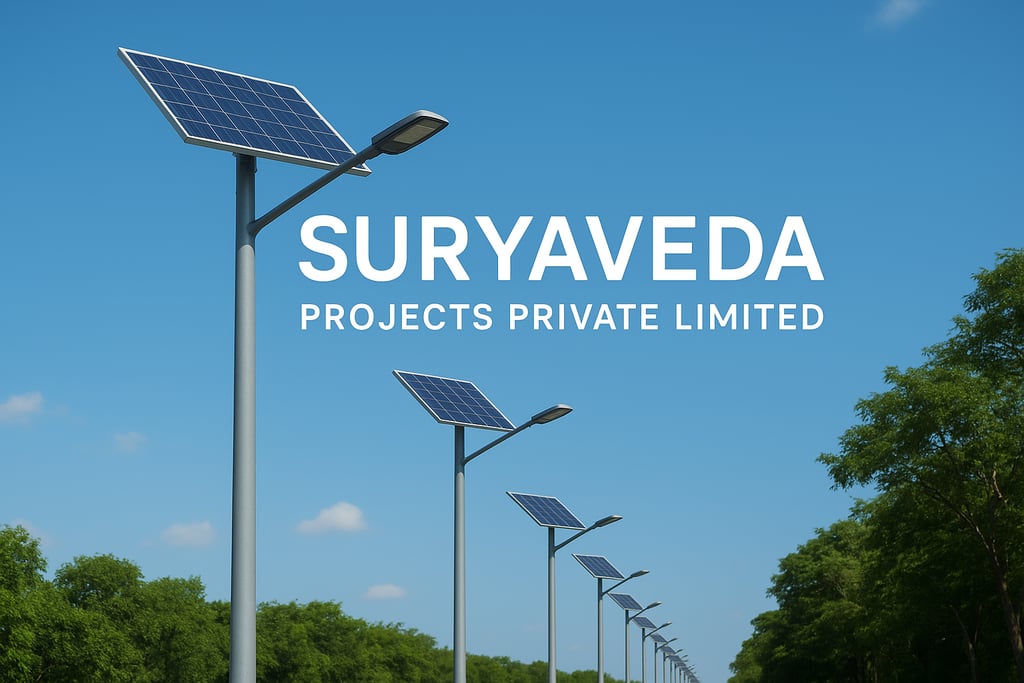
Solar street lights are stand-alone outdoor lighting systems that use solar panels to convert sunlight into electricity. This electricity is stored in rechargeable batteries, which power LED lights during the night.
Unlike traditional street lights:
They don’t require grid electricity
They don’t need underground wiring
They operate automatically
They continue working during power cuts
They reduce maintenance costs drastically
This makes them perfect for developing regions and energy-conscious environments.
Detailed Breakdown of Solar Street Light Components
Understanding the components is crucial for selecting the right lighting system. Each part plays a different role in performance, backup time, and durability.
1️⃣ Solar Panel (The Power Source)
Solar panels are the heart of any solar street light system. They capture sunlight and convert it into electrical energy using photovoltaic (PV) cells. There are mainly two types of solar panels used in street lighting: Monocrystalline and Polycrystalline. Monocrystalline panels are known for their high efficiency and premium performance, especially in low-light or cloudy conditions. Because of their advanced technology and higher output, they are more expensive and commonly used in high-end or large-scale projects. Polycrystalline panels, on the other hand, offer standard efficiency at a more affordable price, making them ideal for budget-friendly installations where cost-effectiveness matters.
When selecting a solar panel, several technical factors should be taken into account. The wattage of the panel determines how quickly it can charge the battery — higher wattage means faster and more reliable charging. Cell efficiency plays a crucial role in performance during cloudy weather or partial shading. Another important factor is the temperature coefficient, which directly affects how well the panel performs in high heat conditions. Additionally, the angle at which the panel is mounted must be optimized to ensure maximum exposure to sunlight throughout the day, enhancing overall energy production.
2️⃣ Battery (The Energy Storage Unit)
The battery is responsible for storing the energy collected during the day and supplying power to the LED lamp throughout the night. It determines how long the solar street light can operate, especially during cloudy or rainy days. Three main types of batteries are commonly used: LiFePO4 (Lithium Iron Phosphate), Lithium-Ion, and Lead-Acid (SMF/GEL).
LiFePO4 batteries are considered the best choice due to their long lifespan of 5–8 years, excellent safety, stability, and lightweight design. They are highly reliable but come at a higher cost. Lithium-ion batteries offer good efficiency and compact size, making them suitable for modern, sleek designs, though they are more sensitive to temperature variations. Lead-Acid batteries, including SMF and GEL types, are the most economical option but come with drawbacks such as heavier weight and shorter lifespan, typically lasting only 1.5–3 years. Each battery type has its own strengths and limitations, so the ideal choice depends on budget, climate, and performance requirements.
3️⃣ LED Light (The Illumination Source)
LED technology is preferred for its brightness, low energy use, and long life.
Quality Indicators in LED Chips
Lumens per watt (lm/W) – Higher = brighter + efficient
Brand – Bridgelux, Philips Lumileds, and CREE provide long-lasting chips
CRI (Color Rendering Index) – Determines clarity and visual comfort
Beam angle – Spread of light on the ground
A good solar street light uses 150–200 lumens per watt LED chips.
4️⃣ Charge Controller (The Intelligent Brain)
Regulates power between the solar panel, battery, and LED lamp.
Types
PWM (Pulse Width Modulation) – Basic, cost-effective
MPPT (Maximum Power Point Tracking) – 30–40% more efficient
Controller Features
Over-charge protection
Deep-discharge protection
Auto on/off sensing
Dimming control
Motion sensor integration
Battery status display
MPPT controllers are recommended for high-performance systems.
5️⃣ Motion Sensor / PIR Sensor (Optional but Beneficial)
Allows the light to operate on dual brightness modes, for example:
30% brightness normally
100% brightness when motion is detected
This improves:
Battery backup
Efficiency
Safety and security
6️⃣ Pole & Mounting Structure
Typically made from GI (Galvanized Iron), MS, or aluminum.
Key factors:
Height (6m–12m based on road width)
Wind resistance
Anti-rust coating
Angle-adjustable panel mount
⚙️ How Solar Street Lights Work (Step-by-Step Process)
🌞 Daytime Operation
Sunlight hits the solar panel
PV cells convert light into DC electricity
The charge controller sends electricity to the battery
A battery stores energy until fully charged
🌙 Nighttime Operation
The light sensor detects darkness
The controller activates the LED lamp
The battery supplies power throughout the night
At sunrise, the system shuts off automatically
This makes the lighting system 100% automatic with no human intervention required.
🏮 Types of Solar Street Lights (In-Depth Explanation)
1️⃣ All-in-One Solar Street Light
A compact unit combining:
Solar panel
LED light
Battery
Charge controller
Sensor
Advantages:
Extremely easy installation
Stylish, modern design
Ideal for homes, societies, small roads, gardens
Limitations:
Limited to lower panel wattage
Best for small-to-medium lighting needs
2️⃣ All-in-Two (Semi-Integrated) Solar Street Light
Battery + LED in one unit
Solar panel separate
Advantages:
Brighter than all-in-one
Larger solar panel options
Flexible installation
Best For:
Wider roads
Rural projects
Municipal lighting
3️⃣ Traditional Solar Street Light with External Battery Box
All components are separate.
Advantages:
Highest brightness levels
Longer backup time
Suitable for highways and large industrial areas
Often Used In:
Government projects
Highway lighting
Industrial zones
🌟 Benefits of Solar Street Lights (Deep Insights)
✔ 1. Zero Electricity Cost
100% energy from the sun = lifetime savings.
✔ 2. No Wiring or Trenching
Reduces installation time and cost by 60–70%.
✔ 3. Works Even During Power Cuts
Perfect for rural or unstable grid regions.
✔ 4. Eco-Friendly
Reduces carbon footprint and air pollution.
✔ 5. Low Operating Costs
Very little maintenance needed.
✔ 6. Easy Scalability
Can be installed anywhere without grid dependency.
✔ 7. Safety & Security
Improves nighttime visibility dramatically.
✔ 8. Ideal for Government and Smart City Projects
Meets sustainability and green-energy goals.
📍 Applications of Solar Street Lights (Where They Work Best)
🔸 Highways & Expressways
Bright, long-range lighting.
🔸 Residential Societies & Gated Communities
Improves safety and appearance.
🔸 Rural Roads & Villages
Perfect where electricity access is limited.
🔸 Industrial Areas & Warehouses
Increases security during night shifts.
🔸 Schools, Hospitals, Government Buildings
Cost-effective and reliable.
🔸 Parking Lots & Commercial Sites
Eliminates high electricity bills.
🔸 Gardens, Parks, Resorts, Farmhouses
Aesthetic and functional lighting.
🔸 Railways & Airports
Highly reliable even during emergencies.
🔍 How to Choose the Right Solar Street Light (Expert Guide)
Key Factors:
Wattage of LED
Lumens required
Battery capacity (Ah)
Backup days (1–3 days)
Pole height (6–12 meters)
Geographical location
Type of solar panel
IP rating (Weather protection)
Material and build quality
Warranty and brand reliability
If you want, I can also prepare a detailed comparison chart for your product catalog.
📝 Conclusion
Solar street lights are a revolution in modern outdoor lighting. They’re cost-efficient, eco-friendly, long-lasting, and independent from the electricity grid. From small residential lanes to large national highways, solar street lights bring brightness without bills, empowering smart cities and rural development alike.
Whether you're a first-time buyer, a developer, or a government planner, understanding these components and types helps you invest in a system that delivers maximum performance for years.
About Us
We are a team of passionate people whose goal is to improve everyone's life through disruptive products. We build great products to solve your business problems.
Our products are designed for small to medium-sized companies willing to optimize their performance.
Contact with us
© 2025 Suryaveda Projects Private Limited. All Rights Reserved.


Call Us: +91 9978652291


Email: info@suryavedaprojects.in